Table of Contents
ToggleBeadboard brings a farmhouse warmth and vertical rhythm to kitchen walls that tile can’t always match. It’s budget-friendly, forgiving for beginner installers, and pairs beautifully with both modern and traditional cabinetry. Whether someone’s aiming for a cottage aesthetic or just tired of scrubbing grout, a beadboard backsplash offers texture, cleanability, and a project that most DIYers can knock out in a weekend. This guide walks through material choices, installation steps, finishing techniques, and maintenance tips to help homeowners confidently add beadboard to their kitchen.
Key Takeaways
- A beadboard backsplash kitchen offers a budget-friendly, DIY-friendly alternative to tile, costing $1–3 per square foot compared to $5–15 for ceramic tile, without requiring mortar or grout skills.
- Choose between solid wood, MDF, or PVC beadboard based on budget and moisture exposure: wood for authentic farmhouse style, MDF for cost savings, and PVC for high-moisture areas prone to splatter.
- Proper preparation—including wall cleaning, degreasing, outlet box extensions, and thorough caulking—is critical for durability and moisture protection in kitchen environments.
- Apply oil-based primer followed by two coats of semi-gloss or satin acrylic latex paint to protect against grease and moisture while maintaining a wipeable, kitchen-grade finish.
- Maintain your beadboard backsplash with weekly damp-cloth cleaning, annual caulk inspections, and promptly recaulking gaps to prevent water damage and extend the life of the installation.
Why Choose Beadboard for Your Kitchen Backsplash
Beadboard delivers classic vertical grooves that add dimension without overwhelming a space. It’s less expensive than tile, material costs typically run $1 to $3 per square foot for panels, compared to $5 to $15 for ceramic tile, and installation doesn’t require mortar, spacers, or grout float skills.
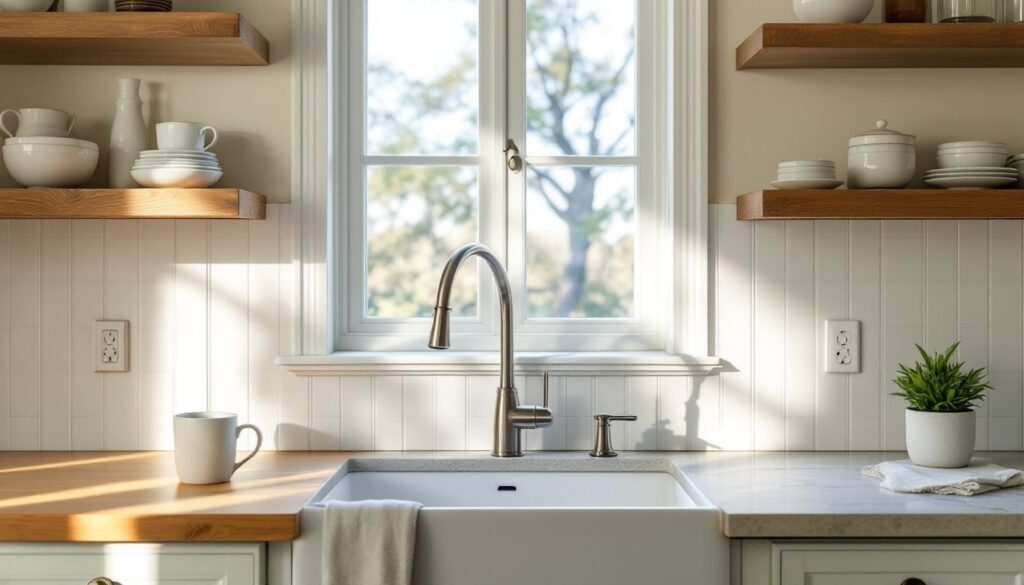
A farmhouse kitchen beadboard backsplash fits naturally with open shelving, apron sinks, and butcher-block counters, but it also works in transitional kitchens when painted in crisp whites or soft grays. The vertical lines make ceilings feel taller, a useful trick in kitchens with standard 8-foot ceilings.
Beadboard is more forgiving than tile during layout. Minor measurement errors or slightly uneven walls won’t ruin the look. Panels and planks can be scribed, trimmed, and caulked to hide imperfections. For renters or anyone hesitant about permanent changes, beadboard is also easier to remove and patch than tile.
That said, beadboard isn’t ideal directly behind cooktops or in areas prone to heavy water splash. It’s best suited for low-splash zones between counters and upper cabinets. In high-moisture areas, choose moisture-resistant materials like PVC or marine-grade plywood, and seal all edges thoroughly.
Types of Beadboard Materials for Kitchen Backsplashes
Choosing the right substrate matters for durability and ease of install. Each material has trade-offs in cost, workability, and moisture resistance.
Wood Beadboard vs. MDF vs. PVC Options
Solid wood beadboard (typically pine or poplar) offers authentic grain and accepts stain beautifully. It’s available in tongue-and-groove planks (usually 3.5 inches wide nominal, 3.25 actual) or 4×8-foot panels with routed beads. Wood is more expensive, expect $2 to $4 per square foot, and requires sealing against moisture. It can expand or contract with humidity, so acclimating the material in the kitchen for 48 hours before install is essential.
MDF beadboard is the budget champion at $1 to $2 per square foot. It cuts cleanly, has no grain to work around, and takes paint evenly. Standard panels come in 4×8 sheets, ¼-inch thick. The downside: MDF swells badly if it gets wet, so it’s not suitable near sinks unless sealed aggressively with oil-based primer and multiple topcoats. Even then, it’s a gamble in a humid kitchen.
PVC beadboard is the moisture-proof option. It won’t rot, swell, or harbor mold. Panels run $3 to $5 per square foot and install with construction adhesive or finish nails. PVC cuts with standard woodworking tools, use a fine-tooth blade to prevent chipping, and doesn’t require priming. Some homeowners dislike the slightly plastic sheen, but a coat of acrylic paint softens that.
For a true farmhouse kitchen beadboard backsplash, many designers lean toward solid wood or high-quality MDF that’s been properly sealed. PVC works better in busy households with kids or heavy cooking routines where splatter is constant.
How to Install a Beadboard Backsplash: Step-by-Step
Most beadboard backsplash installs don’t require permits since they’re non-structural cosmetic work. Always verify local codes, especially if modifying electrical outlets.
Tools needed:
- Table saw or circular saw (a miter saw helps with clean crosscuts)
- Level (4-foot recommended)
- Measuring tape
- Stud finder
- Caulk gun
- Brad nailer (18-gauge) or hammer and finish nails
- Utility knife
- Safety glasses and dust mask
Materials:
- Beadboard panels or planks
- Construction adhesive (PL Premium or equivalent)
- 1¼-inch brad nails or finish nails
- Wood filler (if using wood or MDF)
- Trim molding (chair rail or cap molding for top edge, quarter-round or base shoe for bottom if needed)
- Primer and paint
Step 1: Prep the wall. Remove outlet covers and switch plates. Clean the wall with a degreaser, kitchens accumulate a film that blocks adhesive. Fill any large holes or dents with spackle and sand smooth. Mark stud locations with painter’s tape.
Step 2: Measure and cut panels. Measure the backsplash height from counter to bottom of upper cabinets, typically 18 to 20 inches. Account for any trim that will cap the top and bottom edges. Cut beadboard panels to height using a circular saw with a fine-tooth blade. Cut with the finished side down to minimize tearout.
Step 3: Dry-fit and mark outlets. Hold panels in place and mark any electrical boxes. Outlets must be brought flush with the new surface using box extenders, this is an NEC requirement and prevents fire hazard. Cut outlet holes with a jigsaw or oscillating multi-tool. Double-check measurements: it’s easier to enlarge a hole than patch an oversized one.
Step 4: Apply adhesive and fasten. Run a zigzag bead of construction adhesive on the back of the panel. Press firmly into place, checking level as you go. Secure with brad nails every 12 inches along studs and around edges. If using a hammer and finish nails, predrill to prevent splitting.
Step 5: Install trim. Cap the top edge with a chair rail or simple cap molding to cover the raw edge and create a visual finish line. Use a miter saw for clean 45-degree corners. Nail trim in place, sinking nail heads slightly below the surface. Fill nail holes with wood filler, let dry, and sand smooth.
Step 6: Caulk seams. Run a thin bead of paintable caulk along the bottom edge where beadboard meets the counter, and along any inside corners or seams between panels. Smooth with a damp finger. Caulking is critical for moisture protection, especially with MDF.
Painting and Finishing Your Beadboard Backsplash
Proper prep determines how long the finish lasts in a kitchen environment.
Priming: Use an oil-based stain-blocking primer (like Zinsser Cover Stain or BIN) on MDF or raw wood. Oil-based primer seals better against moisture and prevents tannin bleed on wood. One gallon covers roughly 350 to 400 square feet, so a quart is usually sufficient for a typical backsplash. Let primer dry fully, usually 2 to 4 hours, but check the label. PVC doesn’t strictly need primer, but a coat of bonding primer (like Zinsser Bulls Eye 1-2-3) improves paint adhesion.
Painting: Two coats of semi-gloss or satin acrylic latex paint work best in kitchens. Semi-gloss wipes clean more easily but shows imperfections. Satin hides minor flaws and still scrubs well. Use a small foam roller for flat surfaces and a tapered brush for grooves.
Between coats, lightly sand with 220-grit paper to knock down any raised grain or dust nibs. Wipe with a tack cloth before applying the second coat.
Alternative finishes: For a rustic or farmhouse look, some homeowners leave wood beadboard natural and seal it with polyurethane. Use a water-based poly in satin or matte for a low-sheen finish. Apply three coats, sanding lightly between each. Be aware that any moisture that penetrates the finish can still darken or warp the wood over time.
Avoid flat or matte paint in kitchens, it’s harder to clean and absorbs grease.
Maintaining and Cleaning Beadboard in the Kitchen
Beadboard’s grooves collect grease and dust, so regular cleaning keeps it looking fresh.
Routine cleaning: Wipe down weekly with a damp microfiber cloth and a drop of dish soap. For grooves, use a soft-bristle toothbrush or a damp cotton swab. Avoid abrasive scrubbers, they’ll dull the paint sheen and scratch PVC.
Grease buildup: Mix a solution of warm water and a degreasing cleaner (like Simple Green or a few drops of Dawn dish soap). Spray lightly, let sit for a minute, then wipe clean. Don’t oversaturate MDF or wood, excess water can seep into seams.
Stain removal: For stubborn spots, use a Magic Eraser or a paste of baking soda and water. Test in an inconspicuous area first, melamine sponges can remove sheen from semi-gloss paint if scrubbed too hard.
Long-term care: Inspect caulk lines annually. Recaulk if gaps appear, especially along the countertop. Touch up paint as needed, kitchens are high-traffic, and edges near the sink or stove may chip. Keep a small jar of touch-up paint and a foam brush handy.
If using wood or MDF, watch for signs of moisture damage like swelling, discoloration, or peeling paint. Catching issues early prevents bigger repairs.
Design Ideas and Style Combinations for Beadboard Backsplashes
Beadboard is versatile enough to anchor several kitchen styles.
Farmhouse and cottage: Pair white or cream beadboard with open shelving, butcher-block counters, and vintage-inspired fixtures. A contrasting backsplash material behind the stove, like subway tile or even a patterned cement tile panel, adds interest without losing cohesion.
Coastal and nautical: Paint beadboard in soft aqua, navy, or weathered gray. Combine with white shaker cabinets, brass or bronze hardware, and natural fiber accents. The vertical lines echo the look of ship lap or porch ceilings.
Transitional and modern farmhouse: Use beadboard in a muted greige or charcoal for a contemporary twist. Pair with sleek quartz counters, stainless appliances, and minimal hardware. The texture adds warmth without feeling too country.
Two-tone kitchens: Run beadboard on the backsplash while painting lower cabinets a contrasting color, dark blue or forest green against white beadboard creates strong visual interest. Top cabinets in white or light gray keep the space from feeling too heavy.
Accent zones: Not ready to commit to a full beadboard backsplash? Install it in a breakfast nook, behind a coffee bar, or just between the sink and window as a feature panel. This approach works especially well in kitchens where design inspiration leans eclectic or where multiple materials are already in play.
Trim details: Upgrade the look with decorative chair rail or picture-frame molding at the top edge. Adding a narrow shelf with corbels over the beadboard creates a display ledge for small plants, spice jars, or dishware.
Beadboard’s charm lies in its simplicity. It doesn’t compete with bold tile or busy countertops, it complements them. And because it’s a relatively low-cost, low-skill project, homeowners can experiment with color and layout without the stakes of a full tile job.