Table of Contents
ToggleA bathroom vanity without a sink, sometimes called a vanity cabinet or base, gives homeowners control over both the sink and countertop selection. Instead of settling for a pre-installed basin, buyers can mix and match materials, vessel styles, and plumbing configurations to fit their space and budget. This approach is popular in renovations where existing plumbing dictates sink placement, or when a homeowner wants a specific countertop material that doesn’t come factory-paired with a sink. It’s also a smart move for tight budgets, since purchasing components separately often costs less than buying a complete vanity unit.
Key Takeaways
- A bathroom vanity without a sink is a standalone cabinet base that lets you customize the countertop and sink separately, offering greater design flexibility and cost control than pre-assembled vanity units.
- Choosing a bathroom vanity without a sink can save 20–50% on total cost compared to factory-assembled sets, especially when using DIY-friendly materials like laminate, butcher block, or pre-cut stone remnants.
- Vanities without sinks come in five main types—freestanding, floating, open-shelf, corner, and custom-built—each suited to different bathroom layouts, styles, and storage needs.
- Proper measurement, stud location, and level installation are critical for a successful DIY bathroom vanity without a sink; always secure freestanding units to wall studs and use heavy-duty brackets for floating designs.
- When selecting a bathroom vanity without a sink, prioritize solid wood or plywood construction over particleboard, verify plumbing compatibility, and account for countertop overhang and sink height to ensure comfort and functionality.
What Is a Bathroom Vanity Without a Sink?
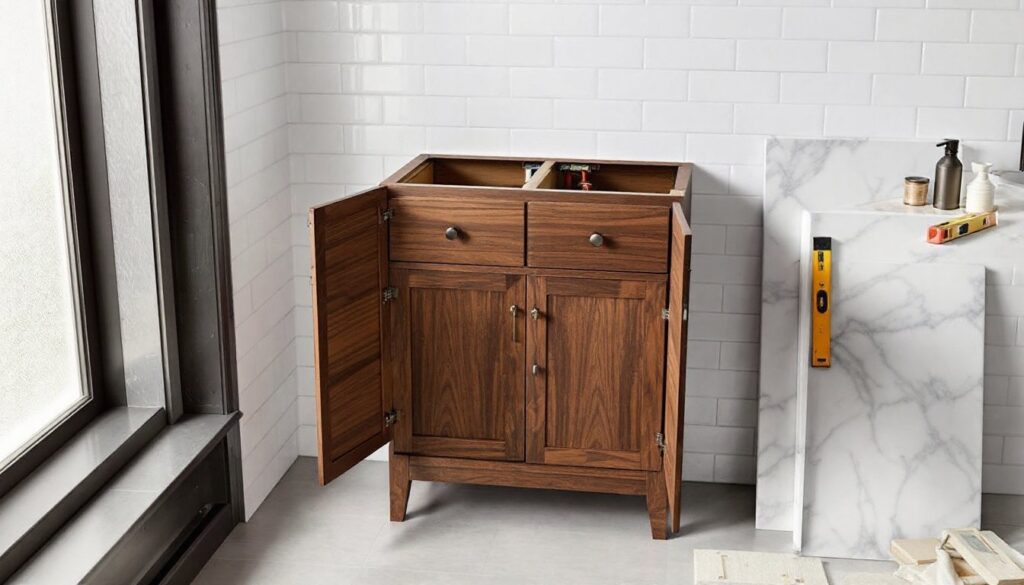
A vanity without a sink is simply the cabinet or base structure that supports a countertop and sink, sold as a standalone piece of furniture. It includes the cabinet box, doors or drawers, and sometimes an unfinished countertop surface, but no basin or faucet hardware.
These cabinets come in the same materials and styles as full vanity sets: solid wood, plywood, MDF, or particleboard with veneer. The key difference is the top. Most vanities without sinks feature an open top frame or a flat surface ready for a stone slab, laminate, or wood countertop to be added later. Some models include a pre-cut countertop with an open hole for a drop-in or undermount sink.
The cabinet interior typically mirrors a standard vanity: shelves, soft-close drawers, or pull-out trays. Plumbing access is handled via a back panel knockout or open back, allowing P-trap and supply line routing. Dimensions follow industry standards, 24″, 30″, 36″, 48″, 60″, and 72″ widths, so they fit standard bathroom layouts without custom carpentry. Depth usually runs 18″ to 21″, matching typical bathroom vanity profiles.
Why Choose a Vanity Without a Sink?
Customization and Flexibility
Buying the base separately lets homeowners pair any sink style with any countertop material. Want a vessel sink on a live-edge walnut slab? A marble top with an undermount porcelain basin? Separate components make that possible without special ordering a factory combo.
This flexibility extends to plumbing, too. If the existing drain and supply lines don’t align with a pre-drilled vanity top, a custom countertop can be cut to match. Older homes with off-center or non-standard plumbing benefit most from this approach. It’s also useful in powder rooms or half-baths where a corner sink or asymmetrical layout works better than a centered basin.
Another advantage: future upgrades. Swapping out just the countertop or sink down the road is simpler and cheaper than replacing an entire vanity unit. A DIYer can refinish or paint the cabinet base while leaving the top in place, or vice versa.
Cost Savings and Budget Control
Separate components often cost less than a factory-assembled unit, especially when shopping sales or remnant materials. A basic 36″ vanity cabinet runs $150–$400, while a pre-made vanity with sink and top starts around $400–$600. Adding a DIY countertop (laminate or butcher block) and a budget undermount sink can keep the total under $350, depending on region and material grade.
Buyers also control where to spend. Splurge on a quartz countertop but pair it with a simple cabinet. Or invest in solid wood cabinetry and use an affordable laminate top. This staged approach works well for phased renovations, install the cabinet now, add the countertop and sink later when budget allows.
Note that cost savings depend on doing some work yourself. Hiring a contractor to template, cut, and install a custom stone top can erase the price advantage. For the best value, stick with materials a DIYer can work with: laminate, butcher block, tile, or pre-cut stone remnants.
Types of Vanities Without Sinks
Freestanding cabinets are the most common type. These standalone units sit on the floor with legs or a solid base, offering storage via doors and drawers. They’re available in traditional, transitional, and modern styles, think shaker doors, flat-panel fronts, or open-shelf designs. Installation is straightforward: level, attach to wall studs for stability, add countertop.
Floating (wall-mounted) vanities attach directly to the wall with a concealed mounting bracket or French cleat. They create a clean, contemporary look and make floor cleaning easier. Weight capacity is critical here, most brackets support 100–150 lbs, so factor in the combined weight of cabinet, countertop, sink, and contents. Always anchor to studs or use heavy-duty toggle bolts rated for the load. Floating vanity designs work especially well in compact or modern bathrooms.
Open-shelf vanities replace enclosed cabinets with exposed shelving, offering a minimalist or farmhouse aesthetic. They’re lighter and easier to install but sacrifice privacy and dust protection. Best suited for powder rooms or guest baths where storage needs are minimal.
Corner vanities maximize space in small or awkward layouts. These are typically freestanding with an angled front, designed to fit into a 90-degree corner. Plumbing access can be tricky, so check that the back panel has ample knockout space before buying.
Custom-built bases are an option for DIYers comfortable with basic carpentry. Using 3/4″ plywood or MDF, a simple frame-and-panel cabinet can be built to exact dimensions. This route makes sense when standard sizes don’t fit, or when matching existing cabinetry is a priority. For woodworking project tutorials, look for plans that detail drawer slide installation, face frame joinery, and finishing techniques.
How to Choose the Right Vanity Without a Sink
Start with measurements. Measure the width of the space, accounting for door swing clearance and any adjacent walls or fixtures. Standard vanity widths increase in 6″ increments, so round down if the space is tight, a 35″ opening calls for a 30″ vanity, not a 36″.
Next, measure the depth. Most bathrooms accommodate an 18″–21″ vanity, but narrow powder rooms may need a 16″ or 17″ depth. Check that the vanity won’t block the toilet or shower door when fully opened. Measure from the back wall to the front edge, including any baseboard or tile.
Consider countertop overhang. A standard overhang adds 1″ to 1.5″ to the front and sides of the cabinet, so factor that into your clearance calculations. Vessel sinks add height, typically 4″ to 6″, so a standard cabinet height of 32″ plus a thick countertop and vessel bowl can push the basin rim to 36″ or higher, which may feel awkward for shorter users. Undermount and drop-in sinks keep the height more manageable.
Material and construction matter for longevity. Solid wood or plywood cabinets handle moisture better than particleboard or MDF, which can swell if water seeps in. Look for dovetail drawer joints and full-extension slides if drawers are included. Soft-close hinges reduce wear and noise.
Finish and style should complement existing fixtures and tile. For design inspiration and curated product guides, browse galleries that show vanity-sink-countertop pairings in context. Pay attention to hardware finish, brushed nickel, matte black, or brass, and make sure the sink faucet and cabinet pulls match.
Plumbing compatibility is non-negotiable. Confirm that the back panel has adequate knockout holes or an open back for the P-trap and supply lines. If the vanity has a back panel, check that it doesn’t interfere with existing plumbing. Wall-mounted faucets require different planning than deck-mounted models, so finalize your faucet choice before drilling any holes.
Finally, think about storage needs. Single-door cabinets with one shelf work fine for guest baths, but a primary bathroom benefits from drawers for small items and dividers for toiletries. If two people share the vanity, a double-sink configuration on a 60″ or 72″ base makes mornings smoother.
Installation Tips for DIY Success
Prep the space first. Remove the old vanity, patch any wall damage, and repaint or retile before the new cabinet goes in. Check the floor for level, shim the cabinet if needed so it doesn’t rock. Sloping floors are common in older homes: a 4-foot level and composite shims solve most issues.
Locate and mark studs. Use a stud finder to identify at least two studs behind the vanity location. Mark them with painter’s tape so you know where to drill. Freestanding vanities need at least one anchor point to prevent tipping: floating vanities require lag bolts into studs at every mounting bracket.
Install the cabinet first, countertop second. Position the cabinet, level it front-to-back and side-to-side, then secure it to the wall with 3″ cabinet screws driven into studs. For floating vanities, follow the manufacturer’s bracket instructions, most require a 2×6 or 2×8 backer board installed between studs if the mounting location doesn’t align.
Cut the countertop to fit. If you’re using laminate or butcher block, a circular saw with a fine-tooth blade works for straight cuts. For curved or sink cutouts, use a jigsaw. Measure twice, cut once, template the sink opening with cardboard first if you’re unsure. Stone and quartz countertops require a wet saw and diamond blade: most DIYers hire this part out or buy a pre-cut remnant from a local fabricator.
Drill faucet and drain holes carefully. Use a hole saw matched to the faucet shank diameter (usually 1-3/8″ for standard faucets). Clamp a backer board beneath the countertop to prevent chip-out on the underside. For stone or tile, use a diamond hole saw and water to cool the bit.
Attach the countertop to the cabinet. Most vanities use L-brackets or corner braces screwed up through the cabinet frame into the underside of the countertop. Don’t overtighten, stone can crack. Some cabinets use a bead of silicone adhesive instead of mechanical fasteners: this method works well for lightweight materials but isn’t recommended for heavy stone without additional support.
Install the sink and plumbing. Follow the sink manufacturer’s instructions for undermount clips or drop-in brackets. Connect the faucet, P-trap, and supply lines, checking for leaks before closing everything up. Use plumber’s putty or silicone for the drain flange, and Teflon tape on threaded pipe connections.
Safety note: Always wear safety glasses when cutting countertops or drilling, and a dust mask if working with MDF or laminate, which produce fine particulates. If the vanity install involves moving or capping old plumbing lines, consult local codes, some jurisdictions require a licensed plumber for supply line work.
A bathroom vanity without a sink opens up design possibilities that factory-set units can’t match. With careful measurement, smart material choices, and patient installation, even a first-time DIYer can achieve a custom look without a custom price tag.