Table of Contents
ToggleIf you’re shopping for cleaner indoor air, you’ve probably stumbled across two terms that sound similar but aren’t quite the same: air purifiers and air scrubbers. Both promise to tackle dust, allergens, and other airborne nasties, but they work in different ways and suit different situations. One plugs into a wall outlet and handles a single room. The other ties into your HVAC system and scrubs air throughout your entire house. Choosing the wrong one can mean wasted money or air quality that doesn’t improve. Here’s what separates them, how each technology works, and which option makes sense for your home.
Key Takeaways
- Air purifiers are portable, single-room solutions that use mechanical HEPA filtration to trap dust and allergens, while air scrubbers integrate into HVAC systems and use active oxidation to treat an entire home.
- An air purifier’s effectiveness depends on its CADR rating matched to room size; a unit rated for 400 square feet won’t improve air quality in a 2,000-square-foot house unless multiple units are installed.
- Air scrubbers require professional installation ($1,000–$2,500) but offer whole-home coverage without daily filter maintenance, making them ideal for homeowners with central ductwork and serious allergies or sensitivities.
- Renters and those without central HVAC should choose a HEPA air purifier for immediate, affordable relief; homeowners planning HVAC upgrades should consider installing an air scrubber for layered, whole-home protection.
- For optimal indoor air quality, combine your chosen technology with proper ventilation, regular filter replacement, and source control measures like humidity management and vented cooking.
What Is an Air Purifier and How Does It Work?
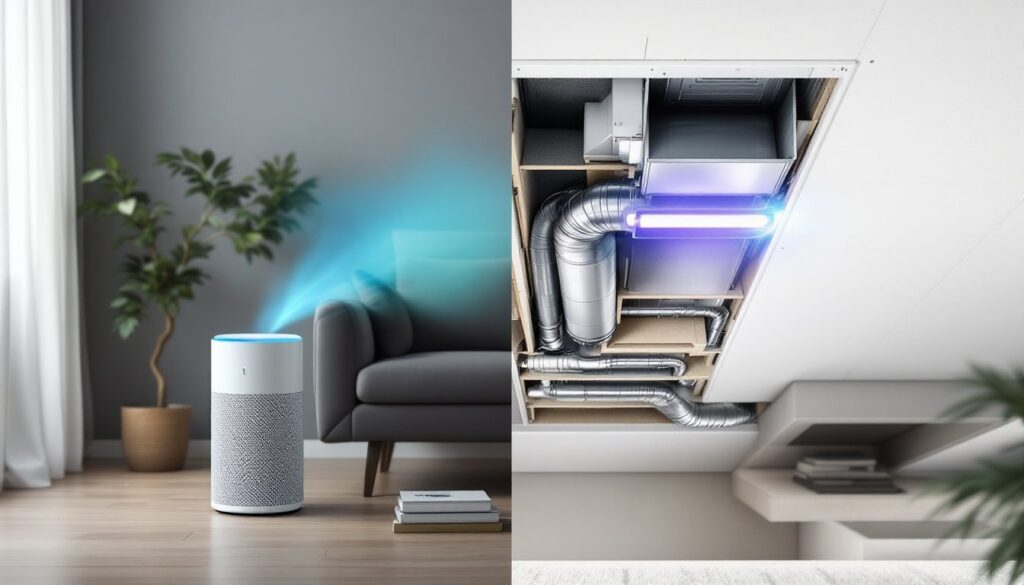
An air purifier is a standalone, portable unit designed to filter air in a single room or zone. Most homeowners recognize them as the cylindrical or box-shaped appliances sitting in a bedroom corner or living room.
They work by drawing room air through one or more filter stages. The most common setup includes:
- Pre-filter: Catches large particles like pet hair and dust bunnies.
- HEPA filter: Traps 99.97% of particles 0.3 microns or larger, including pollen, mold spores, and fine dust.
- Activated carbon filter: Adsorbs odors, VOCs (volatile organic compounds), and smoke.
Some models add UV-C lights or ionizers to kill bacteria and viruses, though these features vary in effectiveness and can produce trace ozone if not designed carefully.
Air purifiers are rated by CADR (Clean Air Delivery Rate), measured in cubic feet per minute. A unit with a CADR of 300 can handle a room up to about 465 square feet with standard 8-foot ceilings, assuming five air changes per hour. Match the CADR to your room size, or the unit will just recirculate dirty air without making a dent.
Most units run on standard 120V household power, require no installation beyond plugging in, and need filter replacements every 6–12 months depending on usage and air quality. You’ll find models ranging from $100 budget units to $800+ commercial-grade options with smart sensors and app control.
What Is an Air Scrubber and How Does It Work?
An air scrubber is a whole-home system that integrates directly into your existing HVAC ductwork. Rather than filtering air in one room, it treats air as your furnace or air handler circulates it throughout the house.
The core difference: air scrubbers use active purification technology, not just passive filtration. Most residential models employ:
- Photocatalytic oxidation (PCO): A UV light reacts with a catalyst (typically titanium dioxide) to produce oxidizing ions and low-level hydrogen peroxide vapor.
- Bipolar ionization: Releases positive and negative ions into the airstream to attach to and neutralize contaminants.
These ions and oxidizers circulate through ducts and into living spaces, where they attack pollutants in the air and on surfaces, countertops, upholstery, even inside cabinets. The goal isn’t just trapping particles: it’s breaking down bacteria, viruses, mold spores, and VOCs at a molecular level.
Installation requires mounting the scrubber unit inside the return air plenum or main trunk line, wiring it to the HVAC system’s power supply, and sometimes adding a dedicated breaker. This isn’t a DIY project for most homeowners, you’ll want an HVAC tech to handle the install and ensure the unit is compatible with your furnace or air handler. Expect $1,000–$2,500 installed, depending on model and labor rates in your area.
Maintenance is lighter than air purifiers: most scrubbers use a replaceable cell or bulb every 1–2 years rather than monthly filter swaps. But if your HVAC system isn’t running, the scrubber isn’t treating air, so they’re less effective in mild weather when heating and cooling are off.
Key Differences Between Air Scrubbers and Air Purifiers
Coverage Area and Installation
Air purifiers treat one room at a time. A unit rated for 400 square feet won’t do much for a 2,000-square-foot house unless you buy multiple units and scatter them around. They’re plug-and-play: no installation, no permits, no contractor needed. Move them from bedroom to home office as needed.
Air scrubbers treat your entire home because they’re installed in the HVAC system. Air circulates through ducts, gets scrubbed, and delivers cleaner air to every room with a supply register. Coverage depends on your home’s total conditioned square footage, most residential scrubbers handle up to 3,000 square feet or more. The trade-off: you need an HVAC system with ductwork, and installation requires a licensed technician. If you have a ductless mini-split or baseboard heat, a scrubber won’t work.
Filtration Technology and Effectiveness
Air purifiers rely on mechanical filtration. HEPA filters physically trap particles as air passes through. They excel at capturing allergens, dust, and pet dander. Activated carbon handles odors and VOCs. The downside: filters clog over time, reducing airflow and efficiency. Testing by independent labs like consumer electronics reviewers confirms HEPA purifiers can drop particulate counts significantly in controlled spaces, but they don’t address surface contamination.
Air scrubbers use active oxidation and ionization. Rather than waiting for pollutants to pass through a filter, they send ions and oxidizers into the air and onto surfaces. This approach can reduce bacteria, viruses, and mold both airborne and on counters, light switches, and bedding. But, effectiveness varies by model, UV bulb intensity, and airflow. Some units also include a basic filter stage to catch larger particles before oxidation. Critics point out that ionization can produce trace ozone, though modern units certified by UL or EPA should stay below the 0.05 ppm safety threshold.
Neither technology removes gases like radon or carbon monoxide, you need dedicated detectors and mitigation for those hazards. And neither replaces proper ventilation. Fresh outdoor air exchange (via ERV or HRV systems) remains the gold standard for IAQ.
Which One Should You Choose for Your Home?
Choose an air purifier if:
- You rent or live in a home without central HVAC.
- You need targeted relief in one or two rooms (bedroom for allergies, nursery for a newborn).
- Your budget is under $500 and you want immediate results.
- You prefer a no-install, portable solution you can take with you when you move.
Look for models with true HEPA filters and a CADR rating that matches your room size. High-end units tested by cleaning and appliance experts often include smart sensors that adjust fan speed based on real-time particulate levels, which saves energy and reduces noise.
Choose an air scrubber if:
- You own your home and have a forced-air HVAC system with ductwork.
- You want whole-home coverage without buying and maintaining multiple units.
- Someone in your household has severe allergies, asthma, or chemical sensitivities.
- You’re already planning HVAC upgrades (new furnace, AC replacement) and can bundle the install.
- You want to address surface contamination, not just airborne particles.
HVAC air scrubbers make the most sense during new construction or major renovations when ductwork is accessible. Retrofitting one into finished spaces can add labor costs. And if your HVAC system is undersized, aging, or has leaky ducts, fix those issues first, an air scrubber can’t overcome poor system performance.
Many leading air purifier comparison guides note that for homeowners with central air, combining a whole-home scrubber with a MERV 13 or higher furnace filter offers layered protection: the filter traps particles, and the scrubber handles VOCs, odors, and microbial contaminants.
Hybrid approach: Some homeowners install a scrubber for baseline whole-home treatment, then add a portable purifier in a high-use room like the primary bedroom. This gives continuous protection plus a boost where it’s needed most.
Conclusion
Air purifiers and air scrubbers aren’t interchangeable, they solve different problems. Purifiers offer affordable, room-level filtration with zero installation. Scrubbers deliver whole-home, active purification by tapping into your HVAC system. For renters and targeted relief, grab a quality HEPA purifier. For homeowners with ductwork and a bigger IAQ challenge, an air scrubber is worth the upfront investment. Either way, pair your choice with proper ventilation, regular filter changes, and source control (fix leaks, vent cooking fumes, and keep humidity below 50%) for the cleanest indoor air possible.