
Table of Contents
ToggleIf you’ve ever lost a week’s worth of food to a failed RV fridge on day two of a cross-country trip, you know why the 12 volt refrigerator matters. Unlike propane or AC-powered units, a 12V fridge runs directly off your RV’s battery system, no hookups, no flame, no hassle. It’s the backbone of off-grid camping, providing reliable cooling whether you’re boondocking in the desert or parked at a trailhead. Choosing the right one, though, means understanding compressor technology, power draw, and install constraints. Here’s what you actually need to know before you buy.
Key Takeaways
- A 12 volt refrigerator for RV provides independent cooling directly from your house battery, eliminating the need for shore power, propane, and the maintenance headaches of absorption fridges.
- Compressor-based 12V fridges are superior to thermoelectric models for RV use, offering consistent cooling in hot climates and drawing only 30–60 amp-hours per day while cycling on and off as needed.
- Proper wiring with correctly sized gauge wire (10 AWG for runs up to 10 feet), inline fuse protection within 18 inches of the battery, and direct connection to house battery are critical for safety and performance.
- Ensure at least 2 inches of clearance around fridge vents and add a thermostat-controlled fan in enclosed spaces to prevent the compressor from overworking and losing efficiency by 20% or more.
- Regular maintenance—including cleaning condenser coils every few months, checking door seals annually, and defrosting when frost exceeds 1/4 inch—extends fridge lifespan and maintains reliable cooling on the road.
- Match your 12V refrigerator capacity to your space and power budget, using a 50-liter model as the baseline for a week’s groceries for two people, and consider upgrading to lithium batteries for serious off-grid camping.
Why Choose a 12 Volt Refrigerator for Your RV?
A 12 volt refrigerator pulls power straight from your RV’s house battery or solar setup, eliminating the need for shore power or propane. That independence is critical if you dry camp frequently or want to avoid the maintenance headaches of absorption fridges (leaks, burner issues, and the need to stay level).
Compared to three-way fridges that run on propane, AC, and DC, a dedicated 12V unit is simpler and more efficient. Modern compressor models draw between 2.5 and 5 amps while running, cycling on and off to maintain temperature. Over 24 headings, that’s roughly 30 to 60 amp-hours depending on ambient temperature, insulation quality, and how often you open the door.
You’ll also sidestep propane regulations at certain campgrounds and tunnels. Some national parks and state facilities restrict or ban open-flame appliances, making a 12V fridge a no-brainer for compliance. Plus, there’s no pilot light to relight or vent to clear, just plug it in and set the thermostat.
Another advantage: portability. Many 12V models come as slide-in units or portable coolers that double as tailgate fridges. If you swap RVs or want to take the fridge on a boat or overland rig, you’re not stuck with a built-in propane box.
Types of 12 Volt RV Refrigerators
Not all 12V fridges work the same way. The two dominant technologies, compressor and thermoelectric, have distinct performance profiles, and knowing the difference will save you from buying the wrong unit.
Compressor vs. Thermoelectric Models
Compressor fridges use a variable-speed compressor and refrigerant loop, just like your home fridge but optimized for 12V DC. They can cool down to 0°F (freezer mode) and maintain consistent temps even in 100°F heat. Expect to pay $400 to $1,200 depending on capacity (measured in liters or quarts). Brands like Dometic, ARB, and Alpicool dominate this space. The compressor cycles on and off, so current draw varies, idle draw is under 1 amp, active draw peaks around 5 amps.
These units excel in hot climates and extended off-grid use. They’re the go-to for serious boondockers and full-timers. Downsides? Heavier (40 to 60 lbs for a 50-liter model) and pricier upfront.
Thermoelectric models use the Peltier effect, passing current through a junction of dissimilar metals to move heat. They’re lightweight, silent, and affordable ($100 to $300), but they can only cool about 40°F below ambient temperature. If it’s 95°F outside, your fridge maxes out at 55°F, not cold enough for safe food storage (FDA recommends 40°F or below). They also run continuously, drawing 4 to 6 amps nonstop, which drains batteries faster than a cycling compressor.
Thermoelectric units work for weekend trips in mild weather or as a supplemental cooler for drinks. For anything longer or hotter, a compressor model is the only practical choice. When researching options, checking reviews of portable refrigerators can help narrow down models that perform well in real-world conditions.
Key Features to Consider When Buying
Capacity is the first spec to nail down. Measure the space where the fridge will sit, height, width, and depth, and compare against the unit’s exterior dimensions. Interior capacity is listed in liters or quarts: a 50-liter (53-quart) fridge holds about a week’s worth of groceries for two people. If you need a freezer compartment, look for dual-zone models with separate controls for fridge and freezer sections.
Insulation thickness directly impacts efficiency. Budget units use 1-inch foam: premium models use 2 to 3 inches of high-density polyurethane. Thicker insulation means the compressor runs less, saving battery power. Check the insulation spec in the manual or ask the manufacturer, it’s not always listed online.
Pay attention to voltage range. Most 12V fridges tolerate 10.5V to 15V, handling voltage sag when your battery is low or voltage spikes during charging. Some units also accept 24V input, handy if you’re running a truck or larger solar array. A built-in low-voltage cutoff (typically around 10.1V or 11.8V, user-selectable) protects your house battery from over-discharge.
Look for digital temperature controls with an external display. Analog dials are imprecise, and you don’t want to open the lid every time you need to check temp. Memory function is useful, if power cuts out, the fridge remembers your setpoint when it powers back on.
Mounting and tie-downs matter if you’re off-road or on rough highways. Fridges should be secured with L-brackets or slide rails, not just wedged between cabinets. Vibration can damage the compressor over time. Some units include mounting hardware: others require you to fabricate brackets.
Finally, consider noise. Compressor fridges hum when running, usually 45 to 55 decibels, about as loud as a normal conversation. If the fridge is near your sleeping area, check reviews for noise complaints. Thermoelectric units are silent but, as noted, less capable.
Installation and Power Consumption Tips
Wiring a 12V fridge is straightforward, but doing it wrong can cause voltage drop, blown fuses, or even fire. Use 10 AWG wire for runs up to 10 feet: drop to 8 AWG for runs up to 20 feet. Undersized wire creates resistance, which wastes power as heat and can damage connectors.
Install an inline fuse or circuit breaker rated for 15 to 20 amps, mounted within 18 inches of the battery. This protects the circuit if the fridge shorts or the wire chafes. Use marine-grade crimp connectors or solder joints, then cover with heat-shrink tubing, no twist-on wire nuts.
Connect directly to the house battery, not the chassis battery (which powers the engine starter). If your RV doesn’t have a house battery isolator or battery management system, add one. Running the fridge off the starter battery will leave you stranded.
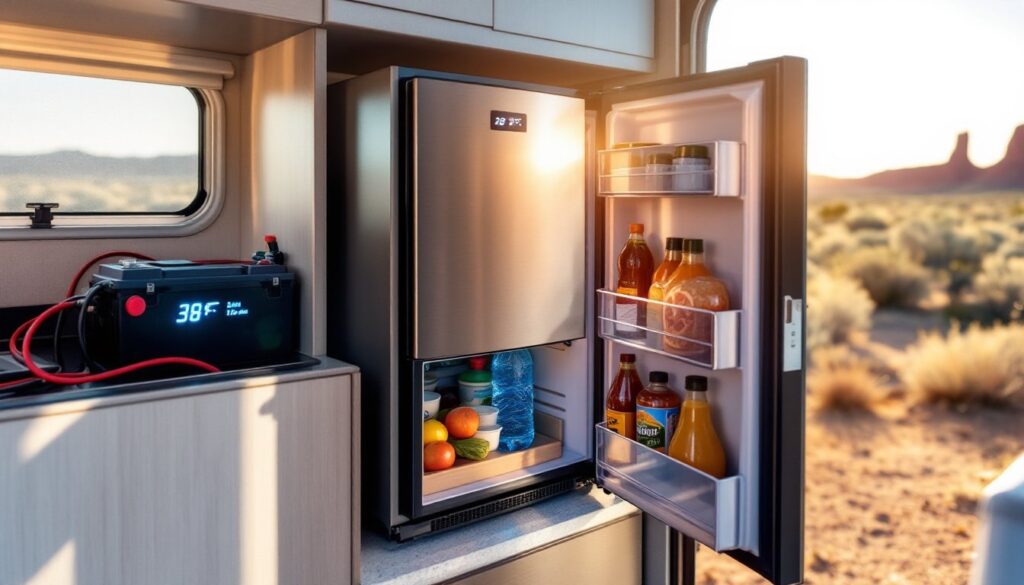
Ventilation is critical. Compressor fridges exhaust heat out the back or sides: block that airflow and efficiency drops by 20% or more. Leave at least 2 inches of clearance around vents. In enclosed cabinets, add a 12V fan to pull hot air out. Some RVers install a small computer fan on a thermostat to kick in when temps rise.
For power budgeting, a typical 50-liter compressor fridge uses 30 to 50 amp-hours per day in moderate temps (70–85°F). In desert heat (100°F+), expect 60 to 80 Ah/day. Match this to your battery bank and charging sources. A single 100 Ah AGM or lithium battery and 200 watts of solar can usually support a fridge, LED lights, and phone charging indefinitely if you’re smart about usage. Small appliances reviewed on sites like appliance testing platforms often include real-world power draw figures that help with planning.
If you’re adding a fridge to an older RV, consider upgrading to lithium batteries. They handle deep discharge better than lead-acid, charge faster, and weigh half as much. The upfront cost is higher, but the lifespan (3,000+ cycles vs. 500 for AGM) makes them worth it for serious off-gridders.
Top Maintenance Practices for Longevity
Keep the condenser coils clean. Dust, pet hair, and road grime reduce heat transfer, forcing the compressor to work harder. Vacuum or brush the coils every few months, more often if you travel dusty roads. Access is usually through a vent panel or by pulling the fridge out slightly.
Check door seals annually. A torn or compressed gasket lets warm air in, cycling the compressor more often. Test the seal by closing the door on a dollar bill: if you can pull it out easily, the gasket needs replacement. Most manufacturers sell replacement seals, and installation is a 10-minute job with a screwdriver.
Monitor voltage at the fridge during operation. If it drops below 12V while the compressor is running, you have a wiring or battery issue. Use a multimeter or install a battery monitor (Victron BMV or similar) to track voltage, current, and amp-hours in real time. This data helps you catch problems before the fridge stops cooling.
Defrost the freezer compartment when frost buildup exceeds 1/4 inch. Frost acts as insulation, reducing cooling efficiency. Turn the unit off, remove contents, and let it thaw, or speed the process with a fan (never a heat gun, which can warp plastic). Wipe dry before restarting.
Secure all mounting hardware periodically. Road vibration loosens bolts and screws. A loose fridge can shift during hard braking, damaging plumbing or wiring. Retighten mounts and check that slide rails or L-brackets are snug.
If you’re storing the RV for weeks or months, leave the fridge door propped open to prevent mold and odors. Disconnect power to avoid parasitic draw. When you’re ready to hit the road, power it up a few hours before loading food to ensure it’s holding temp.
Finally, register your warranty and keep receipts. Compressor failures are rare but not unheard of. Most brands offer 2 to 3 years of coverage: some extend to 5 years for the sealed system. If you’re researching extended coverage or product reliability, expert reviews on home tech platforms often break down long-term performance data.
Conclusion
A 12 volt refrigerator transforms RV life, especially if you camp off-grid. Prioritize a compressor model for reliability, size it to your space and power budget, and don’t skimp on proper wiring or ventilation. With the right setup and routine care, you’ll have cold drinks and fresh food no matter where the road takes you.