Table of Contents
ToggleCabinets aren’t just the biggest visual element in a kitchen, they’re also the single largest expense in most remodels, typically eating up 30–40% of the total budget. Where you buy them determines not just what you’ll pay, but how much design flexibility you get, what kind of support comes with the purchase, and whether your installer will curse your name six months later. The cabinet market has fragmented considerably in the past few years. Big-box stores still dominate the mid-range, but online direct-to-consumer brands have undercut traditional pricing, and local custom shops are thriving at the high end. Here’s how to decide which source makes sense for your project, skill level, and timeline.
Key Takeaways
- Kitchen cabinets typically consume 30–40% of a remodel budget, making the choice of where to buy them critical for both cost and design flexibility.
- Big-box stores like Home Depot and Lowe’s offer stock and semi-custom cabinets at $80–$300 per linear foot with fast shipping, ideal for budget-conscious DIYers and quick projects.
- Online cabinet retailers undercut traditional pricing by 20–40% and provide better standard features like soft-close hardware and plywood construction, but require accurate measurements and DIY assembly.
- Custom cabinet makers deliver heirloom-quality work with unlimited design options starting at $500 per linear foot, best suited for long-term investments and homes with unique architectural features.
- Kitchen showrooms bridge the middle ground between big-box convenience and custom exclusivity, offering expert design assistance and semi-to-custom lines at $250–$600 per linear foot.
- Always factor in hidden costs like delivery, assembly labor, and installation when comparing the best place to buy kitchen cabinets, as a $10,000 order can easily reach $15,000 total.
What to Consider Before Shopping for Kitchen Cabinets
Before comparing vendors, get clear on three project fundamentals: budget, timeline, and installation approach.
Budget should include not just the cabinet boxes, but hardware, delivery, and installation labor if you’re hiring it out. Stock cabinets at big-box stores start around $80–$150 per linear foot. Semi-custom runs $150–$300, and full custom typically starts at $500 and climbs from there. National averages for cabinet costs vary significantly by region and material grade, plywood construction costs more than particleboard but lasts longer.
Timeline matters. Stock cabinets ship within days. Semi-custom orders usually take 4–8 weeks. Full custom work can stretch 10–16 weeks, sometimes longer if the shop is backlogged. If you’re coordinating with a contractor, flooring installer, or countertop fabricator, lead time affects the entire schedule.
Installation approach determines whether you need RTA (ready-to-assemble) cabinets you can handle yourself, or fully assembled boxes that require a truck and extra hands. DIYers comfortable with a drill and level can tackle RTA installs, but full-height pantry units and upper cabinets benefit from a helper and temporary bracing. If the walls aren’t plumb or the floor slopes more than 1/4 inch over 10 feet, plan on shimming and scribing, skills that separate a clean install from a wobbly one.
Big-Box Home Improvement Stores: Accessibility Meets Affordability
Home Depot, Lowe’s, and Menards dominate the stock and semi-custom cabinet market for good reason: they’re everywhere, they’re open evenings and weekends, and you can walk out with samples the same day.
Most big-box retailers carry multiple lines at different price points. Stock cabinets from brands like Hampton Bay (Home Depot) or Diamond NOW (Lowe’s) use particleboard boxes with hardwood face frames and come in standard widths (12″, 15″, 18″, 24″, 30″, 36″). They’re finished on all sides, ship quickly, and are designed for DIY installation. Quality is serviceable for budget flips or starter homes but don’t expect dovetail drawer boxes or soft-close hardware as standard.
Semi-custom lines, like KraftMaid (sold at both chains) or Thomasville (Home Depot), offer more door styles, stain options, and add-ons like pull-out trash bins, lazy Susans, and tray dividers. Lead times stretch to 6–8 weeks, but you get plywood box construction and better hardware. Big-box design services are free, though quality varies by store. Bring measurements and photos: the designer will generate a layout and quote on the spot.
Pros: Immediate samples, free design services, flexible return policies, and the ability to combine a cabinet order with other materials (flooring, countertops, backsplash) on one contractor account.
Cons: Limited customization, cookie-cutter aesthetics, and occasional stock-outs on popular finishes. Installation services are subcontracted and quality is hit-or-miss depending on your zip code.
Online Cabinet Retailers: Convenience and Competitive Pricing
Direct-to-consumer cabinet retailers, Cabinets.com, CabinetsDirect.com, Barker Cabinets, and RTA Cabinet Store, have carved out a niche by cutting showroom overhead and passing savings to buyers. Prices often undercut big-box semi-custom by 20–40%, especially on RTA models.
Most online retailers offer all-plywood construction, soft-close drawer glides, and concealed hinges as standard, features you’d pay extra for at Home Depot. Door styles range from shaker and flat-panel to raised panel and glass-front. Finishes include thermofoil, painted, and stained wood veneers. Some sites offer full custom sizing at semi-custom prices, which is a major advantage if your kitchen has odd ceiling heights or requires filler panels.
The trade-off is that you’re designing the layout yourself (or hiring a designer separately). Most online vendors provide free 3D design tools and phone support, but you’ll need accurate measurements, wall length, ceiling height, window and door locations, and any soffits or protrusions. Mistakes cost time and money, since returns often involve restocking fees and freight charges.
Shipping is another variable. Cabinets ship via freight carrier on a pallet. Curbside delivery is standard: inside delivery and setup cost extra. Inspect everything before signing the delivery receipt, damaged boxes are your responsibility once the driver leaves.
RTA cabinets arrive flat-packed. Assembly isn’t difficult, but it’s time-consuming. Budget 20–40 minutes per box for a first-timer, less once you’ve got the rhythm. A cordless drill, cabinet clamps, and a dead-blow mallet make the job easier.
Pros: Lower prices, better hardware and materials than comparably priced big-box stock, and more customization.
Cons: No physical showroom, freight delivery logistics, assembly required for RTA, and limited recourse if there’s a quality issue after delivery.
Local Cabinet Makers and Custom Shops: Premium Quality and Personalization
If the kitchen is the heart of the home, and you’re planning to stay in it for a decade or more, a local custom cabinet maker delivers the highest quality and most design flexibility, at a price.
Custom shops build cabinets to your exact specifications: ceiling-height uppers, odd-width base units to fit a tricky corner, specialized storage for baking sheets or small appliances, integrated wine racks, or inset doors with hand-planed fit. Materials range from domestic hardwoods (maple, oak, cherry) to exotics like walnut or quarter-sawn white oak. Many kitchen design enthusiasts gravitate toward custom work when aesthetics and longevity matter more than cost.
Construction quality separates custom work from factory-built cabinets. Expect dovetail or box-joint drawer boxes, full-extension soft-close undermount slides, face-frame or frameless (European-style) construction, and finishes applied in a spray booth with multiple coats and hand-sanding between layers. Hardware is often sourced separately, Blum, Grass, or Salice for European hinges, and premium pulls from specialty suppliers.
Custom work requires an in-person consultation and site visit. The cabinet maker measures the space, discusses workflow, reviews door styles and finishes, and generates drawings. Expect at least one revision cycle. Lead times run 10–16 weeks, sometimes longer during busy seasons.
Cost is the obvious drawback. Custom cabinets start around $500 per linear foot and can exceed $1,200 for intricate designs or exotic materials. That said, you’re also supporting a local tradesperson, and the cabinets will likely outlast the house.
Pros: Unlimited design options, heirloom-quality construction, local accountability, and the ability to match existing millwork or architectural details.
Cons: High cost, long lead times, and limited ability to comparison-shop since each shop’s pricing and capabilities vary.
Kitchen Specialty Showrooms: Expert Guidance for Your Investment
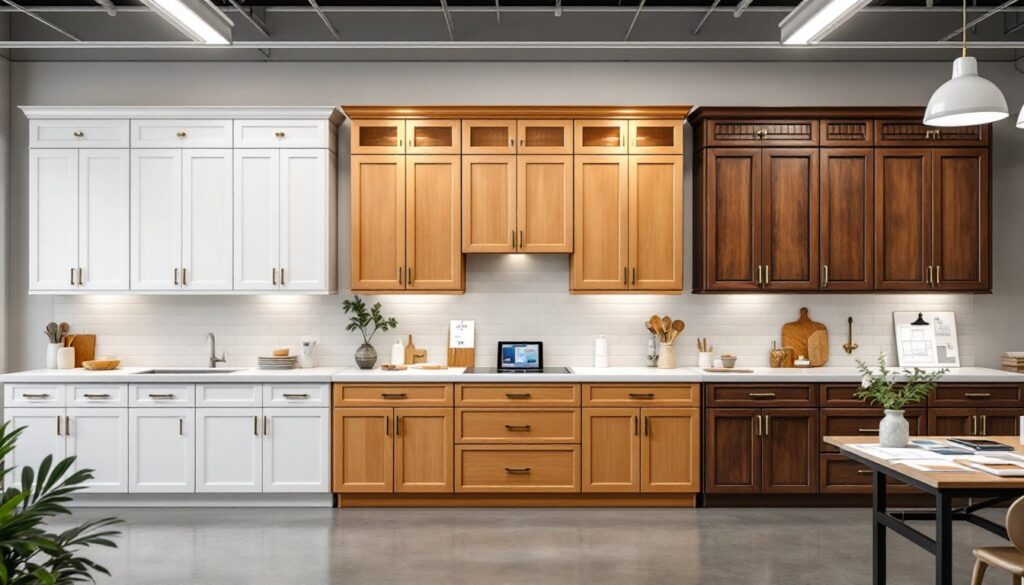
Kitchen and bath showrooms, often independently owned or part of regional chains like Kitchen Classics or Cabinet Discounters, occupy the middle ground between big-box convenience and custom shop exclusivity.
Showrooms carry semi-custom and custom lines from manufacturers like Wellborn, Dura Supreme, Medallion, or Plain & Fancy. You’ll work with an in-house designer who measures your space, creates a 3D rendering, suggests functional improvements (corner solutions, appliance garages, roll-outs), and coordinates finishes with countertop and backsplash samples on-site.
Pricing typically falls between big-box semi-custom and full custom. Expect $250–$600 per linear foot depending on the line, door style, and add-ons. Showrooms often run seasonal promotions or offer package deals that include installation, which can offset the higher base price.
The value proposition is service and expertise. Showroom designers know local building codes, common installation challenges in regional housing stock (baseboard heat, low ceilings, outdated plumbing), and how to maximize storage in tight footprints. They also coordinate delivery and, in many cases, guarantee the installation if you use their recommended contractor.
Some showrooms partner with home renovation platforms to offer financing, project management, and contractor vetting, useful if you’re tackling a full kitchen remodel and need help coordinating multiple trades.
Pros: Expert design assistance, curated product selection, local accountability, and streamlined project coordination.
Cons: Higher pricing than online or big-box, limited to the brands the showroom carries, and appointment-based hours that may not fit a busy schedule.
Which Cabinet Source Is Right for Your Project?
Match the cabinet source to your priorities:
Choose big-box stores if you need cabinets fast, want to see and touch samples in person, and are working with a tight budget. Best for rentals, flips, or starter homes where function trumps aesthetics.
Choose online retailers if you’re comfortable measuring and designing the layout yourself, want better materials and hardware than stock big-box cabinets, and don’t mind assembly and freight logistics. Best for cost-conscious DIYers willing to trade convenience for savings.
Choose a custom cabinet maker if the kitchen is a long-term investment, you have architectural quirks or specific design goals, and budget is flexible. Best for high-end remodels, historic homes, or kitchens where millwork is a defining feature.
Choose a kitchen showroom if you want expert guidance, mid-to-high-end quality, and prefer a single point of contact for design, ordering, and installation. Best for homeowners who value service and accountability over rock-bottom pricing.
Don’t forget to factor in delivery, assembly labor (if hiring it out), and installation. A $10,000 cabinet order can easily become $15,000 once you add freight, a handyman to assemble RTA boxes, and a finish carpenter to install and scribe them. Get itemized quotes from at least two sources, and confirm lead times in writing before placing a deposit.
Conclusion
The best place to buy kitchen cabinets depends on whether you prioritize cost, convenience, customization, or service. Big-box stores and online retailers serve the budget-conscious DIYer. Custom shops and showrooms cater to those chasing quality and design flexibility. Measure twice, compare lead times and total installed cost, and choose the source that aligns with how long you plan to live with the results.